
Dreaming of studying in Germany but worried about the cost? You’re not alone—and the good news is, German scholarships can make your academic journey affordable or even completely free. From bachelor’s to PhD, Germany offers countless opportunities for international students through government, university, and private funding. These scholarships don’t just cover tuition—they often provide living stipends, travel costs, and health insurance. In this guide, we’ll break down exactly how to get them. Whether you’re a high-achieving student or a passionate researcher, there’s likely a scholarship waiting for you. Let’s explore how you can secure one and turn your dream into reality.
Seven practical steps to secure German scholarships
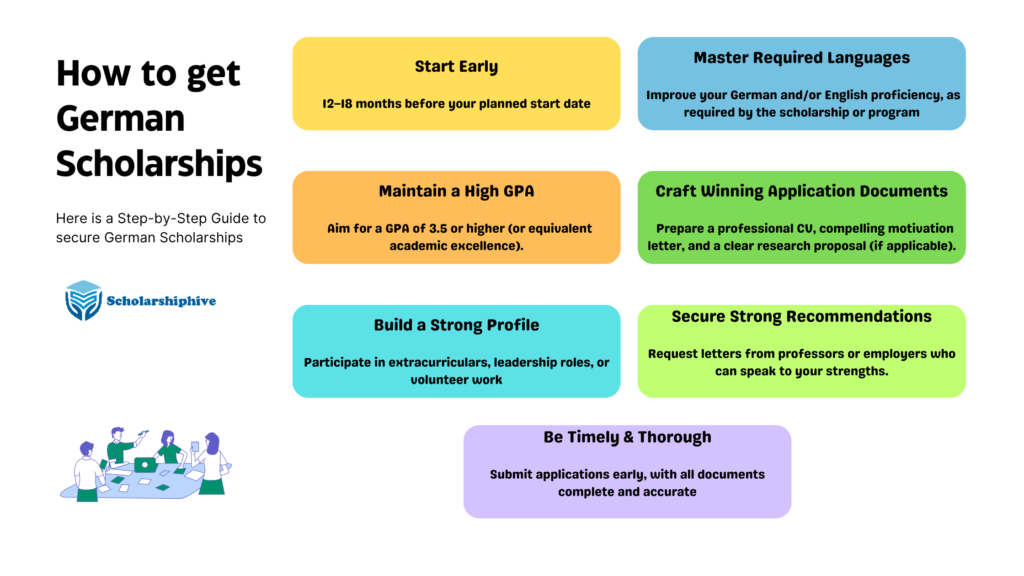
- Research scholarship opportunities early, ideally 12 to 18 months before your intended start date.
- Maintain a strong academic record with a GPA of 3.5 or higher (or equivalent).
- Get involved in extracurricular activities, volunteer work, or leadership roles to strengthen your profile.
- Improve your language skills—both German and English—as required by your program or scholarship.
- Prepare tailored, compelling application documents including a CV, motivation letter, and research proposal.
- Obtain strong recommendation letters from professors or employers who know your work well.
- Submit your applications well before deadlines and ensure all required documents are complete and accurate.
For a complete guide and opportunities, visit Scholarships in Germany
Do German universities give scholarships to international students?
Yes, many German universities offer scholarships specifically for international students.
- Scholarships are provided both by the universities themselves and by external organizations such as DAAD and private foundations.
- The DAAD is a well-known merit-based scholarship available to international students across various institutions.
- Some universities offer tuition waivers or monthly stipends, particularly for master’s and PhD students.
- Several political and non-profit foundations, like Heinrich Böll or Konrad Adenauer, provide scholarships based on merit or social engagement.
- The availability and type of scholarships vary, so thorough research and early applications are essential.
Why it’s powerful and positive: German institutions genuinely want to attract global talent, and with clear criteria and transparent processes, international students have a strong shot at scholarship funding.
Does Germany provide full scholarships for masters?
Germany does offer full scholarships for master’s degrees, especially for outstanding international students.
- The DAAD Master’s Scholarships provide full funding, including tuition fees, a monthly living stipend, travel allowance, and health insurance.
- Erasmus+ Joint Master’s Degrees, though EU-funded, cover tuition and offer monthly stipends for students studying at partner German universities.
- Some German universities (like the University of Freiburg and Technical University of Munich) provide fully funded master’s programs, often connected to specific research projects.
- Employer-sponsored and government-funded scholarships are also available through bilateral agreements with countries like India, Pakistan, and Vietnam.
Why it matters: Full scholarships cover everything—tuition, living, health insurance—so you can focus entirely on your studies and career growth in Germany’s vibrant academic and professional scene.
Are there scholarships for German master studies?
Yes, there are many scholarships available for Master’s studies in Germany.
- DAAD offers a variety of scholarships for master’s students, including full and partial funding options.
- The Deutschlandstipendium provides merit-based scholarships that support master’s students with monthly financial aid.
- Political foundations and private organizations offer scholarships focused on academic excellence and social engagement.
- Universities sometimes provide tuition waivers or financial support specifically for master’s programs.
- Short-term grants and research funding options are also available for master’s students seeking internships or study visits.
- It’s important to research early and apply to multiple scholarships to improve your chances of funding.
Does German PhD have scholarship?
Yes, pursuing a PhD in Germany often comes with scholarships or funded positions.
- Many PhD candidates are employed as research assistants with a salary, which covers living expenses.
- Research institutes like Max Planck and Helmholtz offer fully funded PhD programs and fellowships.
- The DAAD provides research grants for international doctoral students, including stipends and travel allowances.
- EU programs like Marie Sklodowska-Curie Actions offer fully funded PhD positions in Germany.
- Most funding covers tuition, living costs, health insurance, and sometimes additional research expenses.
- Finding a supervisor with a funded project is a common way to secure PhD funding in Germany.
Why it’s empowering: German PhD programs are globally respected, offer financial stability, and often come with teaching or research responsibilities—perfect for academic growth.
Overcoming common challenges
- Learn basic German even if your program is in English to help with daily life, networking, and cultural integration.
- Understand that scholarships are highly competitive; improve your chances by applying to a variety of scholarships including merit-based, partial, and mission-focused ones.
- Submit visa applications early with all required documents to avoid delays, as processing can take 8–12 weeks.
- Find and contact professors whose research aligns with your interests early, sharing your research proposal to demonstrate a good fit.
Also read: How to apply for Germany Visa
Frequently Asked Questions (FAQ)
To get a full scholarship in Germany, you need strong academic performance, clear goals, and early preparation. Applying through DAAD, Erasmus+, or university-specific programs increases your chances significantly.
Start by researching available scholarships on DAAD and university websites, then check the eligibility criteria. Submit a complete application with transcripts, motivation letter, and recommendation letters before the deadline.
Getting a scholarship in Germany is competitive but achievable with a solid profile and a well-crafted application.
The DAAD scholarship is a prestigious German government-funded program for international students at all levels. It typically covers tuition fees, monthly living expenses, travel costs, and health insurance.
Visit the official DAAD website, choose a scholarship program, and review the detailed application process. Then submit your documents—CV, motivation letter, and references—online or through your local DAAD office.
Write a polite email introducing yourself, stating your academic background, and expressing interest in scholarships for a specific program. Ask for guidance on eligibility, deadlines, and the application process, and close with thanks and your contact info.
A GPA equivalent to at least 2.5 on the German scale (around 70% or higher) is typically expected.
Yes, international students can work up to 120 full or 240 half days per year, even on scholarships.
Also Read:
1. DAAD Scholarship Guide
2. Scholarships for Pakistani Students in Germany
3. Scholarships for Indian Students in Germany

