
Dreaming of becoming a doctor and studying at some of the world’s top medical universities? Studying MBBS in UK gives international students the chance to earn a globally recognized medical degree while gaining advanced clinical experience in NHS hospitals. UK medical programs offer 5–6 years of undergraduate training, with options for graduate entry and intercalated research years. Though tuition and living costs can be high, numerous scholarships and financial aid opportunities help ease the burden. Applicants must meet academic, language, and entrance exam requirements, with eligibility varying for Pakistani, Indian, and other international students. Beyond academics, students enjoy multicultural exposure, post-study work options, and access to prestigious institutions. With careful planning and strong preparation, pursuing an MBBS in the UK can be a life-changing step toward a successful medical career.
Why Studying MBBS in UK Is an Incredible Opportunity
Studying MBBS in the UK offers an incredible opportunity to gain a globally recognized medical degree from some of the world’s top universities. With access to advanced clinical training, world-class research, and hands-on experience in the NHS, students develop both skills and confidence to excel anywhere in the world. Despite higher costs, the prestige, career prospects, and international exposure make MBBS in UK a life-changing investment in your future.
Brief Description
Program: MBBS in UK
Coverage: Fully funded or partial scholarships available (tuition + living costs)
Nationality: Open to international students (including Pakistani and Indian students)
Degree Level: Undergraduate (MBBS / MB ChB)
Duration: 5–6 years
University: Various top medical universities across the UK
Host Country: United Kingdom
Key Benefits of Studying MBBS in UK
- Globally Recognized Degree: Prestigious MBBS accepted worldwide.
- World-Class Education: Study at top UK medical universities.
- Clinical Exposure: Hands-on training in NHS hospitals.
- Scholarship Opportunities: MBBS scholarships for international students.
- High Career Prospects: Excellent global job opportunities.
- Cultural Diversity: Multicultural learning experience.
- Post-Study Work Options: Stay for foundation or postgraduate training.
Ready for the UK? Here’s What You Need to Qualify for an MBBS Program
To be eligible for MBBS in UK, you generally need:
- Completion of 12th grade or equivalent with strong grades in Biology, Chemistry, and Physics
- Minimum 60–70% marks (depending on the university)
- Valid English proficiency test score (IELTS/TOEFL)
- UCAT or BMAT exam scores (as required by specific universities)
- Strong personal statement and academic references
- Interview (MMI or panel) for shortlisted candidates
- Proof of financial ability to cover tuition and living costs
- Valid student visa (Tier 4 / Student Route) for international applicants
- For Indian Students: Minimum 60–70% in PCB (Physics, Chemistry, Biology) in Class 12; NEET qualification often required for home recognition.
- For Pakistani Students: Similar high school requirements (strong PCB grades), plus valid student visa and proof of financial support.
Duration of MBBS in UK
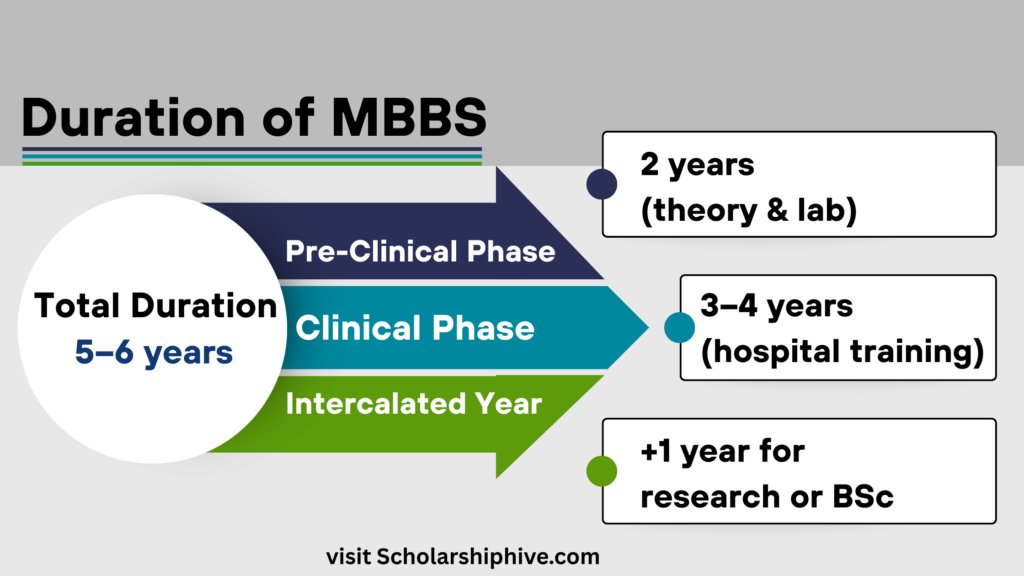
- Total Duration: 5–6 years (4 years for graduate entry)
- Pre-Clinical Phase: First 2 years of theoretical and lab-based study
- Clinical Phase: Final 3–4 years of hospital training and patient care
- Optional Intercalated Year: Adds 1 year for research or an extra degree (BSc)
How Much Does MBBS Cost in UK? (Fees, Expenses & “Cheapest” Options)
- Tuition Fees: £30,000–£50,000+ per year for international students (varies by university and study stage).
- Example: University of Manchester — ~£38,000 for Years 1–2; higher for clinical years.
- Average Range: £22,800–£52,000 annually across UK medical schools.
- High-End Example: University of Cambridge — up to £67,000 per year.
- Living Costs: £10,000–£15,000 yearly (housing, food, transport, insurance, etc.).
- Extra Costs: Lab, uniform, placement, visa, and health surcharge fees.
Affordable Options:
- University of Sunderland — ~£22,000/year
- University of Lincoln — ~£28,700/year
Tip: Check out scholarships, training quality, and accreditation before choosing the cheapest option.
MBBS Scholarships in UK: Reducing the Financial Burden
One of the biggest challenges for many aspirants is funding. Fortunately, scholarship for MBBS in UK do exist, though competition is fierce.
- Hull York Scholarship: ~£2,400 partial award.
- Global Health Leaders: For health & medical students.
- Imperial Medicine Scholarship: Merit-based support.
- Livesey Scholarship (UCLan): Full tuition funded.
- MBBS Excellence (UCLan): £10,000 fee reduction.
- Brunel Medical Scholarship: Multi-year fee discount.
- Rhodes Scholarship: Fully funded global award.
- Other Options: British Council & university grants.
Top-Ranked UK Institutions Offering MBBS Degrees
- London South Bank University
- Roehampton University
- University of Greenwich
- University of Hull
- Buckinghamshire New University
- Middlesex University
- BPP University
- University of Central Lancashire London
- Northumbria University London
- University of Hertfordshire
- The University of Law in London Moorgate campus
- The University of Law in London Bloomsbury Campus
- The University of Law in Manchester Campus
- University of Law in Birmingham Campus
- University of Law (Liverpool Campus)
- University of Portsmouth in London
- Birkbeck University London
- Canterbury Christ Church University
- Cranfield University in London
- Hult International Business School
- University of East Anglia
- Regent College London
- University of Bedfordshire
- University of East London
- University of Gloucestershire
- University of Kent
- University of Plymouth
- University of Reading
- University of Sussex
- Solent University
- Kingston University
- University of Surrey
- Ravensbourne University London
- Ulster University
- UWE Bristol in London
- Keele University
- Staffordshire University
- University of Chester
- Edge Hill University
- University of Huddersfield
- University of Bradford
- University of Salford
- Lancaster University
- University of Bolton
- De Montfort University
- University of Wolverhampton
- Birmingham City University
- Nottingham Trent University
- Coventry University
- Loughborough University
- University College Birmingham
- University of Leicester
- Liverpool John Moores University
- Leeds Trinity University
- University of York
- Leeds Beckett University
- Teesside University
- University of Lincoln
- University of Sheffield
- Bangor University
- University of South Wales
- Cardiff University
- Robert Gordon University
- Abertay University
- University of Dundee
- University of Aberdeen
- University of Strathclyde
- University of Leicester
- Northumbria University
- Cardiff Metropolitan University
- Heriot-Watt University
- Newcastle University
- Queen’s University Belfast
- University of Exeter
- University of Hull(Leeds Campus)
- University of Hull(Sheffield Campus)
- University of Gloucestershire (Birmingham)
- Ulster University (Manchester)
- Ulster University (Birmingham)
- UWE Bristol GREAT (Birmingham)
- Staffordshire University (Birmingham)
- University of Leicester Liverpool)
- Edge Hill University GREAT (Liverpool)
- University of Huddersfield (LEEDS)
- University of Huddersfield (Sheffield)
- University of Bradford (LEEDS)
- University of Bradford (Sheffield)
- Lancaster University Global (Liverpool)
- Nottingham Trent University (Sheffield)
MBBS Opportunities Based on Nationality
UK universities welcome international students, including Pakistani and Indian applicants, with specific eligibility and scholarship options. Opportunities and requirements may vary depending on nationality, academic background, and financial capacity.
Scholarship Opportunities Across All Disciplines
Discover numerous fully funded scholarship opportunities for all academic disciplines in the UK:
- Scholarships in Uk
- Bachelor’s scholarships
- MBA Scholarships in UK
- Scholarships for Masters in UK
- Scholarships for LLB in UK
- Commonwealth scholarship
- Chevening scholarship
Everything You Need to Know Before Starting Your Studies in the UK
Here’s your all-in-one guide — from visas and scholarships to housing, university registration, and everyday essentials.
- Biometric Residence Permit: ID card for stays over 6 months with photo and immigration status.
- National Insurance Number: Needed to work and access benefits.
- Accommodation: University halls or private/shared housing.
- Top Universities in Uk: Oxford, Cambridge, UCL, Imperial, LSE.
- University Enrollment: Submit documents, pay fees, attend orientation.
- UK Visa: Official permission to enter and study in the UK.
- Student Visa: Apply with CAS, finances, and English proof.
- Bank Account: Requires passport, visa, address proof, enrollment letter.
Key Challenges in Studying MBBS Abroad
- Very high costs (tuition + living).
- Intense competition for admission and scholarships.
- Visa and immigration hurdles, including proof of funds.
- Some universities may limit international student numbers.
- Returning to home country might require extra exams or equivalence processes.
- Cultural adjustment, weather, distance from home, and homesickness.
All these should be weighed carefully before committing.
Tips for Winning Scholarships
- Maintain excellent grades and test scores.
- Demonstrate leadership, volunteer service, and research interest.
- Prepare strong personal statements and interview skills.
- Apply early and fulfill all eligibility criteria (financial proof, references).
- Explore smaller departmental scholarships or bursaries (sometimes delivered at the local level).
- Some scholarships may be automatically considered (you don’t need separate application) — check with the university.
Required Documents for MBBS in UK
- Academic Transcripts: 12th grade or equivalent marksheets
- English Proficiency Test: IELTS or TOEFL score
- Entrance Test Scores: UCAT or BMAT (if required)
- Personal Statement: Highlighting motivation and achievements
- Letters of Recommendation: Academic or professional references
- Passport: Valid for the entire duration of study
- Financial Proof: Bank statements or scholarship award letters
- Medical Certificates: Health and vaccination records
- Visa Documents: For international students (Student Route/Tier 4)
Application Process for MBBS in UK
Here, we explain the entire application process in detail, from preparing your documents to submitting your application successfully:
- Research Universities: Shortlist top MBBS colleges in the UK based on eligibility, fees, and scholarships.
- Prepare Documents: Gather transcripts, personal statements, recommendation letters, test scores, and financial proof.
- Entrance Exams: Take required tests like UCAT or BMAT if applicable.
- UCAS Application: Submit applications through the UCAS portal before the deadline.
- Interviews: Attend MMI or panel interviews if shortlisted by universities.
- Receive Offer: Conditional or unconditional offers based on academic and interview performance.
- Accept Offer & Apply for Visa: Confirm admission and apply for a UK student visa with all necessary documents.
- Enroll & Start Course: Complete university registration and begin MBBS program.
Frequently Asked Questions (FAQ)
Some scholarships require a confirmed admission, while a few merit-based or external scholarships may allow applications beforehand. Always check the specific scholarship criteria.
The MBBS program typically lasts 5–6 years, with 4 years for graduate entry courses and an optional intercalated year for research.
Meet eligibility criteria (12th-grade PCB, English proficiency), take required exams (UCAT/BMAT), apply via UCAS, attend interviews, and secure a student visa.
Tuition for international students ranges from £22,000 to £50,000 per year, plus living expenses of around £10,000–£15,000 annually.
Yes, international students can work up to 20 hours per week during term and full-time during vacations under a student visa, but clinical training and study commitments may limit work hours.
Need Help with Your Study Abroad Plans?
Get expert guidance for admissions and scholarships in UK, Italy, Canada 🇨🇦, USA, China, Germany, and Denmark.
Visit at:
𝐋𝐚𝐡𝐨𝐫𝐞 𝐎𝐟𝐟𝐢𝐜𝐞 (𝐇𝐞𝐚𝐝 𝐎𝐟𝐟𝐢𝐜𝐞): 4, Block R3, Phase 2 Johar Town, Lahore, Pakistan
𝐈𝐬𝐥𝐚𝐦𝐚𝐛𝐚𝐝 𝐎𝐟𝐟𝐢𝐜𝐞 (𝐍𝐞𝐰 𝐁𝐫𝐚𝐧𝐜𝐡): Beverly Centre, Jinnah Avenue F-6/1, Blue Area, Islamabad
Call now for a free discussion: +92 326 1980849

