
Studying in the UK is a dream for many international students, but the cost of tuition and living expenses can be overwhelming. The good news is that numerous opportunities exist for students to secure fully funded scholarships. With the right strategy, documents, and understanding of the application process, you can transform your dream into reality. This comprehensive guide will show you step by step how to get UK scholarships, covering everything from eligibility criteria to interview tips, and highlighting the best scholarships to study.
Why Study in the UK?
The UK offers high-quality education at globally recognized universities with diverse programs. Many programs are available in English, making them accessible for international students. The country provides a rich cultural experience with historic cities, vibrant student life, and excellent networking opportunities. Generous scholarships, high employability after graduation, and sometimes scholarships without IELTS make studying a smart, rewarding choice.
Seven Practical Steps to Secure UK Scholarships
- Research scholarships (government-funded, university-specific, private).
- Maintain strong academic records.
- Prepare language proficiency if required (IELTS, TOEFL, or alternatives).
- Write tailored motivational letters and personal statements.
- Apply early to multiple scholarships.
- Prepare for scholarship interview questions in the UK if needed.
- Follow up and get ready for admission and visa processes.
Are Scholarships Available to International Students at Universities in the UK?
Yes, UK universities do offer scholarships to international students.
- Scholarships can be merit-based or need-based.
- They may cover partial or full tuition fees.
- Some scholarships include living allowances or travel grants.
- Government-funded scholarships like Chevening and Commonwealth provide full coverage.
- Many universities offer departmental or program-specific funding.
- Check out each university’s website for specific scholarship details and eligibility.
Who Is Eligible to Study in the UK?
- A foreign secondary or tertiary diploma recognized in the UK.
- Minimum GPA or academic performance (varies by program).
- Language proficiency: IELTS/TOEFL for English, though some scholarships without IELTS exist.
- Nationality or specific groups for certain scholarships (e.g., Commonwealth students).
- Sometimes age, level (Bachelor/Master/PhD), and field of study restrictions apply.
So, international students (non-EU, EU, developing countries) can apply, provided they meet academic and language criteria.
Can I Apply for a UK Scholarship Without an Admission Offer?
A common concern among students is whether an admission offer is mandatory before applying. The answer varies depending on the scholarship:
- Some scholarships, like Chevening scholarship or Commonwealth scholarships, allow applications before an admission offer.
- University-specific scholarships usually need admission first.
Is It Hard to Get a Scholarship in the UK?
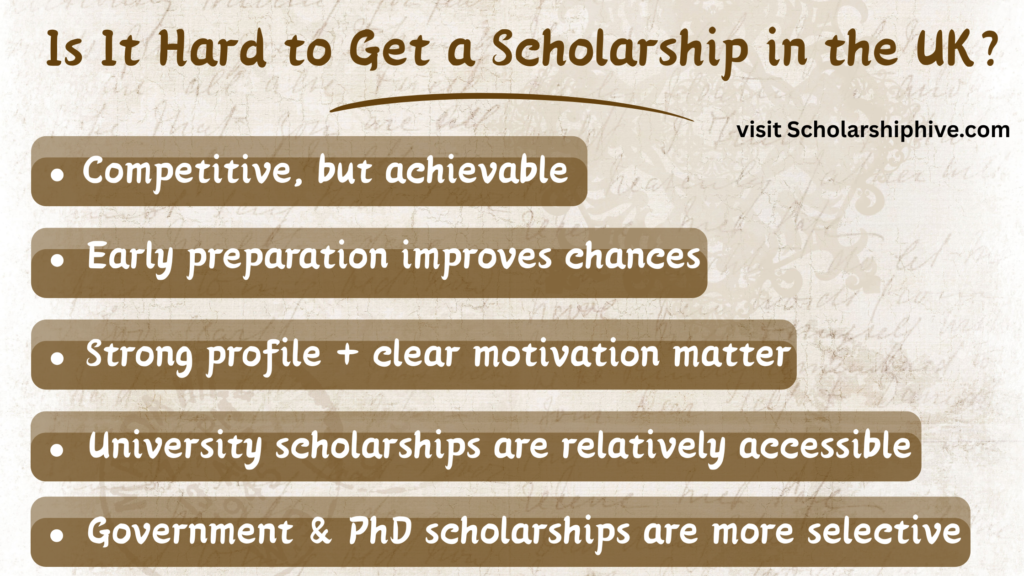
You might wonder, is it hard to get a scholarship in the UK? The truth is:
- It’s competitive but not impossible.
- Selectivity depends on funding sources: government and PhD scholarships are more competitive; university grants may be more accessible.
- Preparation matters: early planning, strong documents, real motivation, and aligning your profile with scholarship criteria makes a big difference.
While challenging, it’s certainly doable if approached strategically.
UK Universities Offering Scholarships
- London South Bank University
- Roehampton University
- University of Greenwich
- University of Hull
- Buckinghamshire New University
- Middlesex University
- BPP University
- University of Central Lancashire London
- Northumbria University London
- University of Hertfordshire
- The University of Law in London Moorgate campus
- The University of Law in London Bloomsbury Campus
- The University of Law in Manchester Campus
- University of Law in Birmingham Campus
- University of Law (Liverpool Campus)
- University of Portsmouth in London
- Birkbeck University London
- Canterbury Christ Church University
- Cranfield University in London
- Hult International Business School
- University of East Anglia
- Regent College London
- University of Bedfordshire
- University of East London
- University of Gloucestershire
- University of Kent
- University of Plymouth
- University of Reading
- University of Sussex
- Solent University
- Kingston University
- University of Surrey
- Ravensbourne University London
- Ulster University
- UWE Bristol in London
- Keele University
- Staffordshire University
- University of Chester
- Edge Hill University
- University of Huddersfield
- University of Bradford
- University of Salford
- Lancaster University
- University of Bolton
- De Montfort University
- University of Wolverhampton
- Birmingham City University
- Nottingham Trent University
- Coventry University
- Loughborough University
- University College Birmingham
- University of Leicester
- Liverpool John Moores University
- Leeds Trinity University
- University of York
- Leeds Beckett University
- Teesside University
- University of Lincoln
- University of Sheffield
- Bangor University
- University of South Wales
- Cardiff University
- Robert Gordon University
- Abertay University
- University of Dundee
- University of Aberdeen
- University of Strathclyde
- University of Leicester
- Northumbria University
- Cardiff Metropolitan University
- Heriot-Watt University
- Newcastle University
- Queen’s University Belfast
- University of Exeter
- University of Hull(Leeds Campus)
- University of Hull(Sheffield Campus)
- University of Gloucestershire (Birmingham)
- Ulster University (Manchester)
- Ulster University (Birmingham)
- UWE Bristol GREAT (Birmingham)
- Staffordshire University (Birmingham)
- University of Leicester Liverpool)
- Edge Hill University GREAT (Liverpool)
- University of Huddersfield (LEEDS)
- University of Huddersfield (Sheffield)
- University of Bradford (LEEDS)
- University of Bradford (Sheffield)
- Lancaster University Global (Liverpool)
- Nottingham Trent University (Sheffield)
Scholarships for International Students
The UK provides numerous scholarships for talented international students. These awards often cover full tuition and living expenses, enabling scholars to focus on advanced studies or research. Students from countries such as India, Pakistan, and other nations can benefit from fully funded opportunities at leading UK universities.
Scholarships in UK
Studying in the UK can be made affordable through various scholarships. To succeed, research available programs, check eligibility, and prepare strong applications with transcripts, recommendations, and a personal statement. Meeting deadlines and tailoring your application increases your chances. Knowing how to get UK scholarships effectively opens doors to quality education.
Bachelor’s Scholarships in the UK
The UK offers a variety of Opportunities for undergraduate (Bachelor’s) degrees:
- Includes university-specific scholarships, regional grants, and private funding.
- Scholarships can cover tuition fees, living expenses, or both.
- Available in many fields: engineering, sciences, arts, business, and more.
- Most common type of scholarship for international students pursuing a Bachelor’s in the UK.
Master’s Scholarships in the UK: Are There Options?
The UK offers a wide range of Programs for master’s degrees:
- Includes Chevening Scholarship UK, Commonwealth funding, and university grants.
- Scholarships can cover tuition, living expenses, or both.
- Available in many fields: engineering, humanities, sciences, arts, business, and more.
- Most common type of scholarship for international students in the UK.
Does the UK Offer PhD Scholarships?
- Most PhD positions come with a full scholarship.
- PhD scholarships typically include a monthly stipend, tuition waiver, and research funding.
- Many are competitive and merit based.
- Some are co-funded by Erasmus+ or other research programs.
Thus, students can pursue PhD programs with scholarships, often fully funded if selected.
Are There Scholarships for MBBS (Medicine) Studies in the UK?
- Scholarships for MBBS are limited and competitive.
- Mostly offered by universities or regional authorities.
- Require strong academic background and sometimes English proficiency.
- Government scholarships rarely cover full MBBS tuition, but partial grants exist.
- Check out universities like the University of London, University of Edinburgh, and King’s College London for specific opportunities.
Does the UK Offer Scholarships for MBA Programs?
- Many business schools offer merit-based MBA scholarships.
- Partial tuition waivers or fellowships are common; full scholarships are rare.
- Some scholarships target international students with leadership potential and work experience.
- Schools like London Business School, Imperial College Business School, and University of Manchester offer dedicated MBA funding.
- Erasmus+ programs may also support MBA candidates.
Does the UK Offer LLB Scholarships?
- Most LLB programs offer merit-based or need-based scholarships.
- Scholarships can include tuition fee coverage, living allowances, or both.
- Many are competitive and awarded based on academic excellence.
- Some scholarships are co-funded by universities or private law foundations.
Thus, students can pursue LLB programs with scholarships, often partially or fully funded if selected.
How to Handle Common Problems
- Set reminders to avoid missing deadlines.
- Take language courses and prepare early for tests.
- Double-check all application documents.
- Apply for your visa promptly and follow up.
- Seek additional funding or part-time jobs if needed.
- Join student groups to combat homesickness.
- Use tutoring and manage time to handle academic challenges.
Studying in the UK: A Step-by-Step Guide for Student
- Biometric Residence Permit: ID card for stays over 6 months with photo and immigration status.
- National Insurance Number: Needed to work and access benefits.
- Accommodation: University halls or private/shared housing.
- Top Universities in Uk: Oxford, Cambridge, UCL, Imperial, LSE.
- University Enrollment: Submit documents, pay fees, attend orientation.
- UK Visa: Official permission to enter and study in the UK.
- Student Visa: Apply with CAS, finances, and English proof.
- Bank Account: Requires passport, visa, address proof, enrollment letter.
Documents Required for UK Scholarships
Essential documents often include:
- Academic transcripts
- Degree certificates
- Personal statement or statement of purpose
- CV or resume
- Reference letters
- Passport copy
- English proficiency proof (if applicable)
Organizing documents early ensures timely application submission.
Step by Step Guide to Get UK Scholarships
1: Research Scholarships – Find programs matching your background and course.
2: Check Eligibility Criteria – Academic excellence, English proficiency, leadership.
3: Prepare Documents Required for UK Scholarships.
4: Craft Your Application – Highlight achievements, leadership, and career goals.
5: Submit on Time – Follow instructions and meet deadlines.
6: Prepare for Scholarship Interview – Practice answers for scholarship interview questions in the UK.
7: Follow Up – Respond promptly to request additional documents.
Frequently Asked Questions (FAQ)
Many UK scholarships for international students in 2025 are fully funded, covering tuition fees, living expenses, and sometimes travel allowances. Examples include Chevening Scholarship UK and Commonwealth scholarships UK.
International students can secure scholarships by researching opportunities, meeting eligibility criteria for UK scholarships, preparing the required documents, and following the UK scholarships application process carefully. A strong academic record and leadership qualities improve chances.
Top scholarships include:
Chevening Scholarship UK
Commonwealth Scholarships UK
Gates Cambridge Scholarships
Rhodes Scholarship
University-specific awards at Oxford, Cambridge, UCL, and Imperial College
UK scholarships are highly competitive due to the limited number of fully funded awards. Applicants are evaluated on academics, leadership, work experience, research potential, and alignment with scholarship goals.
Yes, students can apply for multiple scholarships but check individual rules. Some scholarships may require exclusivity, while others allow concurrent applications to increase your chances of success.
Need Help with Your Study Abroad Plans?
Get expert guidance for admissions and scholarships in UK, Italy, Canada 🇨🇦, USA, China, Germany, and Denmark.
Visit at:
𝐋𝐚𝐡𝐨𝐫𝐞 𝐎𝐟𝐟𝐢𝐜𝐞 (𝐇𝐞𝐚𝐝 𝐎𝐟𝐟𝐢𝐜𝐞): 4, Block R3, Phase 2 Johar Town, Lahore, Pakistan
𝐈𝐬𝐥𝐚𝐦𝐚𝐛𝐚𝐝 𝐎𝐟𝐟𝐢𝐜𝐞 (𝐍𝐞𝐰 𝐁𝐫𝐚𝐧𝐜𝐡): Beverly Centre, Jinnah Avenue F-6/1, Blue Area, Islamabad
Call now for a free discussion: +92 326 1980849

