
If you’re planning to stay in Italy long-term, understanding how to apply for a residence permit in Italy is essential. Whether you’re coming to work in Italy, study, or join family, non-EU nationals must have a valid visa to enter and submit their application form within 8 days of arrival in Italy. You’ll need to visit post offices to start the process, then attend the immigration office or police headquarters to complete your permesso di soggiorno (permit to stay). Requirements include proof of sufficient income, accommodation, and health insurance. While EU citizens have simpler rules, non-EU applicants must follow strict timelines to legally begin residing in Italy. For students, obtaining a residence permit is also necessary to access university facilities, receive scholarships in Italy, and manage official paperwork during their studies.
Why You Should Get a Residence Permit in Italy
- Legal right to stay in Italy
- Permission to work (if permit allows)
- Access to public healthcare and services
- Ability to travel within the Schengen Area
- Option to renew and extend your stay
- Pathway to permanent residency or citizenship
- Eligibility for family reunification
- Access to public education for children
- Ability to rent housing and open bank accounts
- Legal protection under Italian law
Types of Residence Permit in Italy
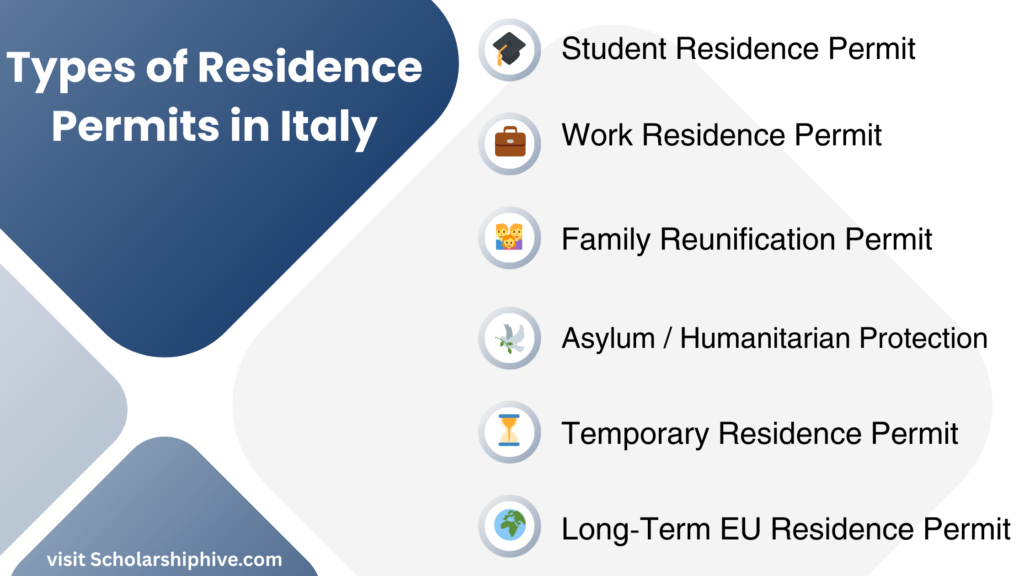
Here, we explore the different categories of residence permits in Italy, breaking down each type in detail:
- Student Residence Permit: Issued to non-EU nationals enrolled in academic programs lasting more than 90 days.
- Work Residence Permit: Granted to individuals with employment or self-employment opportunities in Italy.
- Family Reunification Permit: Allows family members of legal residents or citizens to join them in Italy.
- Asylum or Humanitarian Protection Permit: Given to those seeking protection due to persecution or humanitarian reasons.
- Temporary Residence Permit: Covers short-term stays for specific reasons like study, medical treatment, or research.
- Elective Residence Permit: For financially independent individuals who wish to live in Italy without working.
- Conversion Permit: Allows switching from one type of residence permit to another (e.g., student to work).
- Long-Term EU Residence Permit (Permanent): Available after 5 years of legal stay, offering more rights and long-term EU mobility.
Who is Eligible for a Residence Permit in Italy?
You are eligible to apply for a residence permit in Italy if you are a non-EU citizen who enters Italy with a valid long-stay visa (Type D) for one of the following purposes:
- Study – enrolled in a recognized academic or training program
- Work – with a valid employment or self-employment contract
- Family reunification – joining a legally residing family member in Italy
- Elective residence – financially independent individuals wishing to live in Italy without working
- Humanitarian protection/asylum – individuals seeking international protection
- Medical treatment, research, or other special reasons recognized by Italian law
You must apply for the permit within 8 days of arriving in Italy, and your visa must match the purpose of your stay.
Documents Needed for a Residence Permit Italy
To apply, gather these essential documents:
- Passport and valid Italian visa (e.g., a long‑stay “D” visa for students).
- Italy residence permit application form / online application form for Italy residence permit — available at Italian Post Office or downloadable.
- Documents proving purpose of stay (University enrollment letter (for student permits), Employment contract, Proof of family connection)
- Proof of accommodation: lease agreement or university housing confirmation.
- Health insurance: private or national health system coverage.
- Financial means: bank statements, scholarship award letter.
- Passport-size photos, biometric data.
- Stamped postal envelope for mailing your application (via “kit postale”).
For Indian or Pakistani students, additional documents may include:
- Academic transcripts / diplomas.
- No‑criminal record certificate, sometimes notarized and legalized.
- Language certificates, if required by the host university.
How to Apply for a Residence Permit in Italy
This section provides a comprehensive guide on how to apply for a residence permit in Italy, outlining each step of the application process clearly and thoroughly:
1st Step: Enter Italy and Collect the Application Kit
- Arrive in Italy with a valid long-stay visa (e.g., student, work, family).
- Within 8 days, go to a local Post Office (Poste Italiane) and collect the residence permit application kit.
- Fill out the form and gather required documents.
2nd Step: Submit the Application and Pay the Fees
- Submit your completed application kit at the Post Office.
- Pay the necessary residence permit fees (usually around €100, including administrative costs).
- Receive a receipt (ricevuta) with a tracking number and your scheduled appointment at the Questura (immigration office).
3rd Step: Attend the Questura Appointment and Collect Your Permit
- Go to the Questura on your assigned date with original documents.
- Provide biometric data (fingerprints and photograph).
- Wait for 1–3 months for processing.
- Once approved, collect your residence permit card from the Questura.
Frequently Asked Questions (FAQ)
To get temporary residency in Italy, you must:
1: Enter Italy with a valid long-stay visa (e.g., for study, work, or family reasons).
Within 8 days of arrival, apply for a temporary residence permit at a Poste Italiane office using the official application kit.
2: Submit the completed application with required documents, pay the fees, and attend an appointment at the Questura (immigration office) for fingerprinting.
3: Your temporary permit is usually valid for 6–12 months and can be renewed if the original reason (e.g., study or work) continues.
No, you cannot work in Italy with an Italian residence permit unless you have a long-term EU permit and meet Italy’s specific requirements.
It usually takes 1 to 3 months after your Questura appointment.
Get it at any Poste Italiane branch or download it from www.portaleimmigrazione.it.
Yes, if the permit allows work (e.g., for employment). Students can work part-time up to 20 hours/week. Some permits (like elective residence) do not allow work.
Related Articles

