
Dream of studying in a country where history meets innovation and education is world-class yet affordable? Look no further than the universities in Italy, where ancient campuses, modern research, and global diversity come together. From public universities in Italy to internationally ranked institutions, students worldwide are drawn to its excellence. With many top universities in Italy offering English-taught programs, scholarships, and even free education, the opportunities are endless. This guide unlocks the best academic paths Italy has to offer—without the high price tag.
What Makes Italian Universities a Great Choice?
Studying in Italy combines world-class education, rich culture, and affordability. Here’s why thousands of students choose universities in Italy every year:
- Historic Excellence – Home to the world’s oldest university (Bologna) and top-ranked institutions.
- Affordable Education – Low tuition at public universities in Italy, with options for free education.
- No Application Fees – Many universities don’t charge application fees.
- English-Taught Programs – Widely available in MBA, PhD, engineering, medicine, and more.
- International Student Support – Smooth visa process and integration help for newcomers.
- Cultural Experience – Study in iconic cities like Rome, Milan, Florence, and Venice.
- Strategic Location – Travel easily across Europe while studying.
- Career-Friendly – Internships, research opportunities, and post-study work visas available.
- Scholarships Available – Numerous funding options for both EU and non-EU students.
List of Universities in Italy
- University of Tasmania
- University of Rome Tor Vergata
- University of Siena
- University of Modena
- University of Bologna
- University of Cassino
- University of Pisa
- University of Ferrara
- Politecnico di Milano
- University of Foggia
- University of Campania Luigi Vanvitelli
- University of Naples Federico II
- University of Eastern Piedmont
- University of Macerata
- University of Padova
- Sapienza University of Rome
- University of Palermo
- University of Turin
- University of Milano Bicocca
- SISSA Trieste
- University of Politecnico di Torino
- Scuola IMT Alti Studi Lucca
- University of Sant’Anna
- University of Venice
- University of Bolzano
- University of Trento
- University of Bergamo
- University of Pavia
- University of Genoa
- University of Camerino
- University of Florence
- University of L’Aquila
- Marche Polytechnic University
- University of Tuscia
- University of Parma
- University of Trieste
- University of Insubria
- University of Milan
- University of Messina
- University of Catania
- University of Brescia
- University of Sassari
- University of Calabria
- Polytechnic University of Bari
- Roma Tre University
- University of Bari Aldo Moro
- University of Basilicata
- University of Salento
- University of Salerno
- University of Teramo
- University of Cagliari
- University of Udine
How to Choose the Right University in Italy
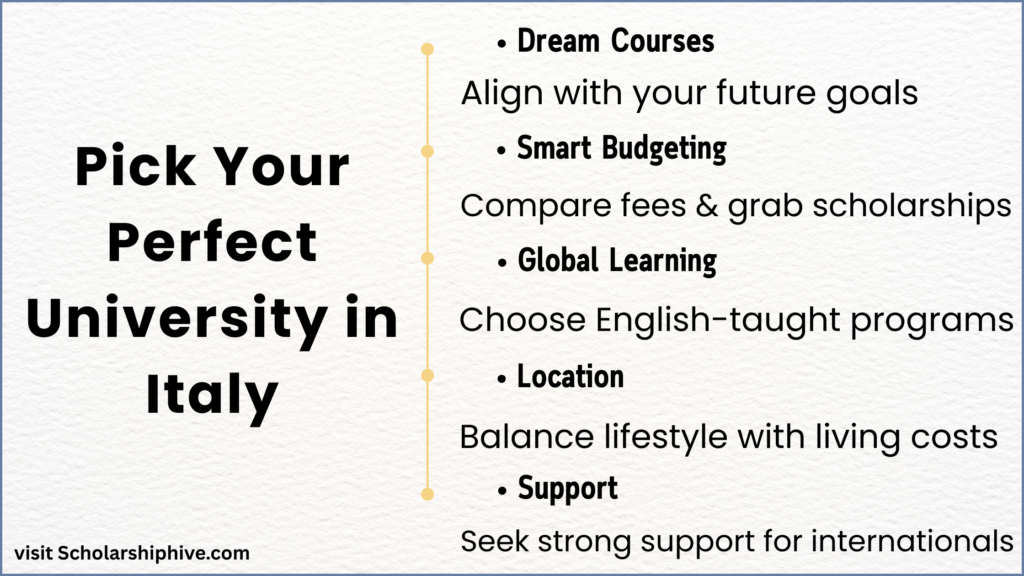
With a vast list of universities in Italy, making the right choice can be daunting. Consider factors like:
- Course offerings aligned with your career goals
- Availability of English-taught programs
- Tuition fees and scholarships
- Location and lifestyle
- Support services for international students
Common Eligibility Criteria for Universities in Italy
Undergraduate Programs (bachelor’s degree)
- Completion of secondary school diploma (equivalent to Italian high school diploma).
- Meeting the minimum grade or GPA requirements set by the university.
- Proof of language proficiency (Italian or English, depending on the program).
- Sometimes passing an entrance exam or interview (especially for medicine, architecture, and design).
Master’s Programs
- Bachelor’s degree or equivalent from a recognized university.
- Minimum GPA or academic performance as required by the program.
- Relevant background in the field of study (e.g., engineering degree for engineering master’s).
- Proof of language proficiency (IELTS, TOEFL, or Italian language test).
- Submission of a motivation letter, CV, and sometimes letters of recommendation.
Explore Scholarships for Master’s Programs in Italy
PhD Programs
- Master’s degree or equivalent in a relevant field.
- Strong academic record and research experience.
- Research proposal aligned with the department’s expertise.
- Language proficiency proof (English or Italian).
- Letters of recommendation and sometimes an interview.
Learn More About PhD Programs in Italy
General Requirements
- Valid passport and visa (for non-EU students).
- Application submitted before the university’s deadline.
- For some programs, an entrance test or interview may be required.
- No criminal record and good health condition (sometimes required).
Application Tips for Universities in Italy
- Research universities and programs thoroughly; check for English-taught courses.
- Prepare all required documents early (transcripts, language certificates, motivation letter, CV, etc.).
- Apply via university portals or centralized platforms like Uni-Italia.
- Start visa application early; gather all necessary documents.
- Learn basic Italian to ease daily life and meet course requirements if needed.
Also Read How to get Italy Scholarships
Documents Required for University Admission in Italy
- Valid passport
- Academic transcripts and certificates
- Statement of Purpose (SOP)
- CV/Resume
- Letters of recommendation
- English/Italian language certificate (IELTS, TOEFL, etc.)
- Portfolio (for design/arts programs)
- Passport-sized photos
- Pre-enrollment form (for non-EU students)
- Declaration of Value or CIMEA certification
- Proof of financial means
- Health insurance
- Completed university application form
Step-by-Step Guide: Application Process for Universities in Italy

Applying to universities in Italy involves the following steps:
- Choose your program and university – Use platforms like Universitaly or individual university websites to find your course.
- Check admission requirements – This may include transcripts, language proficiency (English or Italian), entrance exams, or specific documents.
- Submit a pre-application – Non-EU students must often pre-enroll through the Italian consulate in their home country.
- Apply online – Some universities accept applications via their websites, while others use centralized platforms.
- Apply for an Italian visa – Once accepted, apply for a student visa (Type D).
- Seek scholarships – You may qualify for regional scholarships like DSU or EDISU, especially in public universities in Italy.
Tip: Many universities in Italy without application fee allow you to apply for free, saving upfront costs.
Frequently Asked Questions (FAQ)
1: Choose your course and preferred university.
2: Check admission requirements on the official university website.
3: Apply online or via the Universitaly portal.
4: Non-EU students must pre-enroll through the Italian embassy or consulate.
5: After acceptance, apply for a student visa and available scholarships (like DSU or EDISU).
Yes, especially at public universities. Many offer income-based tuition, which can be reduced to zero for eligible students. Scholarships like DSU cover tuition, accommodation, and meals. Some universities do not charge application fees, and there is special financial support for students from countries like India and Pakistan.
Related Articles

