
If you’ve ever dreamed of studying in scenic Italy, the student visa for Italy is your golden ticket. Whether you’re looking into an Italy student visa or trying to navigate the Italian student visa‑application maze, this comprehensive guide walks you through every essential step. Written in a clear, friendly tone, this article covers everything from the student visa Italy process to the Italy student visa fee, along with requirements specific to Indian and Pakistani applicants. We also tackle Italy student visa processing time, the Italy student visa rejection rate, documents required for Italian student visa, and even student visa interview questions for Italy—plus much more.
Key Benefits of Obtaining a Student Visa for Italy
- World-class education at top universities like the University of Bologna and Politecnico di Milano
- Affordable tuition fees ranging from €900 to €4,000 per year at public universities
- Lower cost of living in student-friendly cities like Padua and Bologna
- Visa-free travel across 26 Schengen countries while studying in Italy
- Legal permission to work part-time (20 hours/week) and full-time during holidays
- Immersive experience in Italian language, culture, art, and cuisine
- 12-month post-study stay option to search for a job or start a business
- Option to convert student visa into a work permit after employment
- Years on a student visa count toward permanent residency eligibility
- Strong international student support and multilingual services
- Access to scholarships and financial aid, including for non-EU students
Eligibility Criteria for Student Visa for Italy
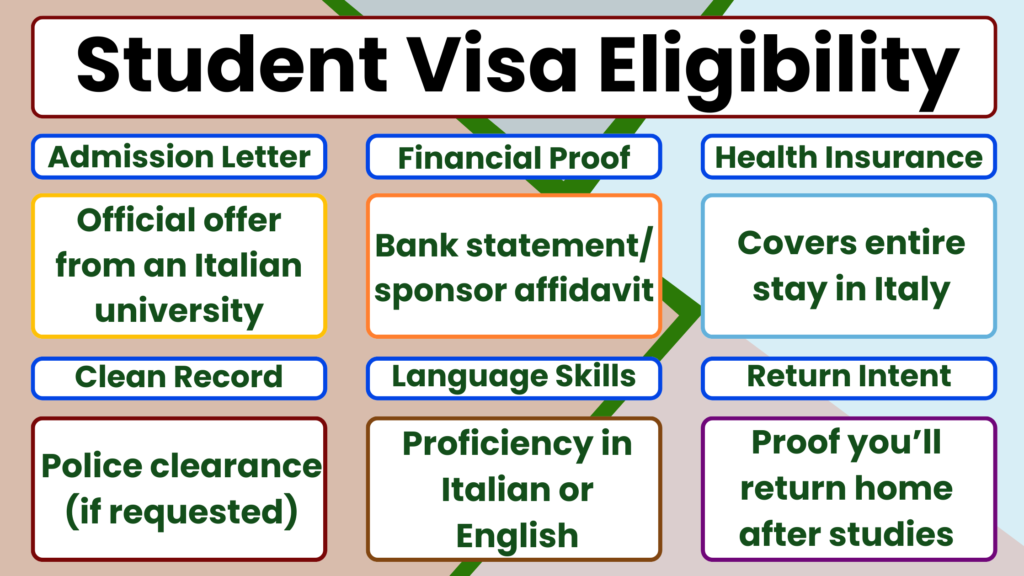
- Admission Letter: Must have an official admission from a recognized Italian university.
- Financial Proof: Show sufficient funds or an affidavit of support to cover expenses.
- Health Insurance: Valid insurance covering your entire stay in Italy.
- Criminal Record: Provide a clean police clearance if requested by the consulate.
- Language Skills: Demonstrate proficiency in Italian or English as required.
- Return Intent: Prove your intention to return home after studies.
- Academic Qualifications: Meet the minimum age and educational requirements.
- Additional Documents: Indian and Pakistani applicants may need extra papers like NOC or police clearance certificates.
Italy Student Visa Fee
The Italy student visa fee depends on nationality and local consulate. As of mid‑2025, Indian students typically pay about €116 (~₹10,000), while Pakistani students may pay slightly more or equivalent in PKR. Always check the local consulate website for up‑to‑date fees.
Italy Student Visa Processing Time
The Italy student visa processing time typically ranges from 15 to 60 days, depending on season (peak summer intake slows it), completeness of documents, and home consulate workload. As a rule of thumb, apply at least 2–3 months before your program start date.
Affidavit of Support for Student Visa Italy
The affidavit of support for student visa Italy is a legal document—often notarized—that confirms a sponsor (typically your parents) will fund your studies. This document:
- Lists the sponsor’s name, relationship to you, income details, and commitment to financial support.
- Provides proof of stable income (salary slips, tax returns) and assets.
- Is often supplemented by bank certificates or statements.
Whether you’re applying as an Indian or Pakistani student, the affidavit can significantly strengthen your case under Italian visa requirements for students and reduce the odds of rejection.
Italy Student Visa Rejection Rate
While precise statistics vary by region, consulates often reject around 5–10% of student visas due to incomplete documentation, insufficient funds, or doubts about intent to return home. The Italian student visa rejection rate for Indian and Pakistani applicants traditionally hovers in that range.
Common Reasons for Rejection
- Incomplete or improperly translated documents
- Insufficient financial proof or inadequate affidavit of support for student visa Italy
- Unclear acceptance letter or no visa‑compliant course
- Gaps in study history or previous visa violations
- Incoherent or weak responses during the student visa interview questions for Italy
Tips to Reduce Italian Student Visa Rejection Rate
Here’s how to keep your chances high and rejection low:
- Submit a complete, error‑free application file.
- Provide proof of authentic funds including the affidavit of support for student visa.
- Be honest and prepared in the interview: answer student visa interview questions clearly.
- Show intention to return home after studies (strong ties).
- For Pakistani applicants, obtain and include all extra documents like police clearance.
- Book a visa appointment early in the application cycle (peak season slots get filled quickly).
Everything You Need to Know About Applying for an Italian Visa
Italian Student Visa Interview Questions
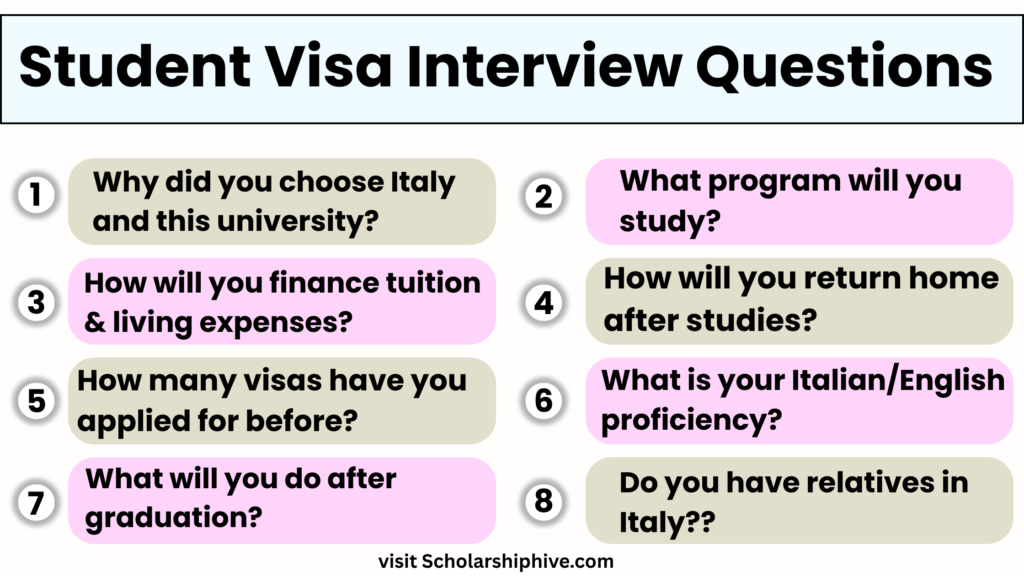
Proper preparation for the student visa interview is crucial. Common student visa interview questions include:
- Why did you choose Italy and this university?
- What course will you study, and what is the duration?
- How do you plan to finance your education and living expenses?
- Will you be bringing any dependents?
- How will you return to your home country after completing studies?
- How many visas have you applied for previously? Any rejections?
- Do you have relatives in Italy?
- How is your Italian (language) proficiency?
- What are your plans after graduation?
Answer clearly, confidently, and honestly—it leaves a good impression and fits all student visa requirements.
Required Documents
To meet the Italian visa requirements for students, you’ll need a set of documents. Here’s the detailed list:
- A valid passport with at least two blank pages and expiry date at least 3 months after intended departure from Italy.
- A completed visa application form (typically the Italian student visa application form).
- Two recent passport‑size photos (meet biometric specification).
- Letter of admission from an Italian university or educational institution.
- Evidence of sufficient funds, often via affidavit of support for student visa or bank statements showing you have at least €8,000–€11,000 per year (varies by region).
- Proof of health insurance that covers the entire period of stay in Schengen (EU).
- Italian student visa fee payment receipt.
- Proof of accommodation in Italy (hotel booking, dorm contract, or rental).
- A statement of purpose or personal statement outlining the reasons for study.
- Academic transcripts, diplomas, certificates, and language proficiency test results (ex: IELTS, TOEFL, or Italian‑language test).
- For Indian and Pakistani students, additional documentation such as proof of no criminal record, or viva‑voce/attestation depending on embassy preference.
Apply for Italian student visa: Step by Step
- Secure admission and receive your acceptance letter
- Arrange financial guarantees (bank statements or affidavit)
- Purchase health insurance approved by Italian authorities
- Complete and sign the official visa application form
- Book appointment at the Italian consulate or visa application center
- Pay Italian student visa fee
- Submit your documents required for Italian student visa
- Attend student visa interview questions (if needed)
- Wait for processing
- Collect visa and travel to Italy
Frequently Asked Questions (FAQs)
You should demonstrate a minimum of €6,000–€7,000 to cover living expenses for one academic year. This amount can be shown through your own bank account or a sponsor’s affidavit of support. Requirements may vary slightly depending on the consulate and the duration of your course.
No, you cannot enter Italy before the official start date indicated on your student visa. Early entry is not permitted and may result in denial at immigration. To avoid any issues, ensure you travel only once your visa becomes valid.
Yes, student visa holders are allowed to work up to 20 hours per week during the academic year. However, you must first obtain a valid residence permit before starting any job. Some positions may also require knowledge of Italian or approval from your university
The success rate for obtaining a student visa for Italy is generally high, typically around 85% to 90%. This means most applicants who submit complete and accurate documentation, including proof of admission, financial means, and insurance, are approved.
IELTS is not always mandatory for an student visa, but it depends on the university and the language of instruction.
Related Articles

